
Value Engineering
What Is Value Engineering?
You've heard the term. But ask five different people what "value engineering" actually means, and you'll get five different answers.
For some, it's a polite way of saying "we need to cut costs." For others, it's a last-minute scramble to save a project that came in over budget. Neither is quite right.
Properly understood, value engineering is a structured process for making sure every dollar you spend contributes to the value of the finished project. When done right, it doesn't reduce quality, but it protects it.
Here's Where it Began
Value engineering originated in manufacturing during World War II. Engineers at General Electric faced material shortages and were forced to find substitutes. To their surprise, the alternatives were often better and cheaper than the originals.
The insight was simple. Instead of asking "how do we make this cheaper?" they asked "what does this need to do, and what's the best way to achieve that?"
This is the core of value engineering. It's defined as a systematic method for improving the value of a project by analysing its functions and finding ways to deliver those functions at lower cost - without sacrificing quality, performance, or reliability.
Value is the ratio of function to cost:
Value = Function ÷ Cost
You increase value by improving function, reducing cost, or both.
Value Engineering vs Cost Cutting
This distinction matters because it determines whether your cost reduction preserves or damages the project.
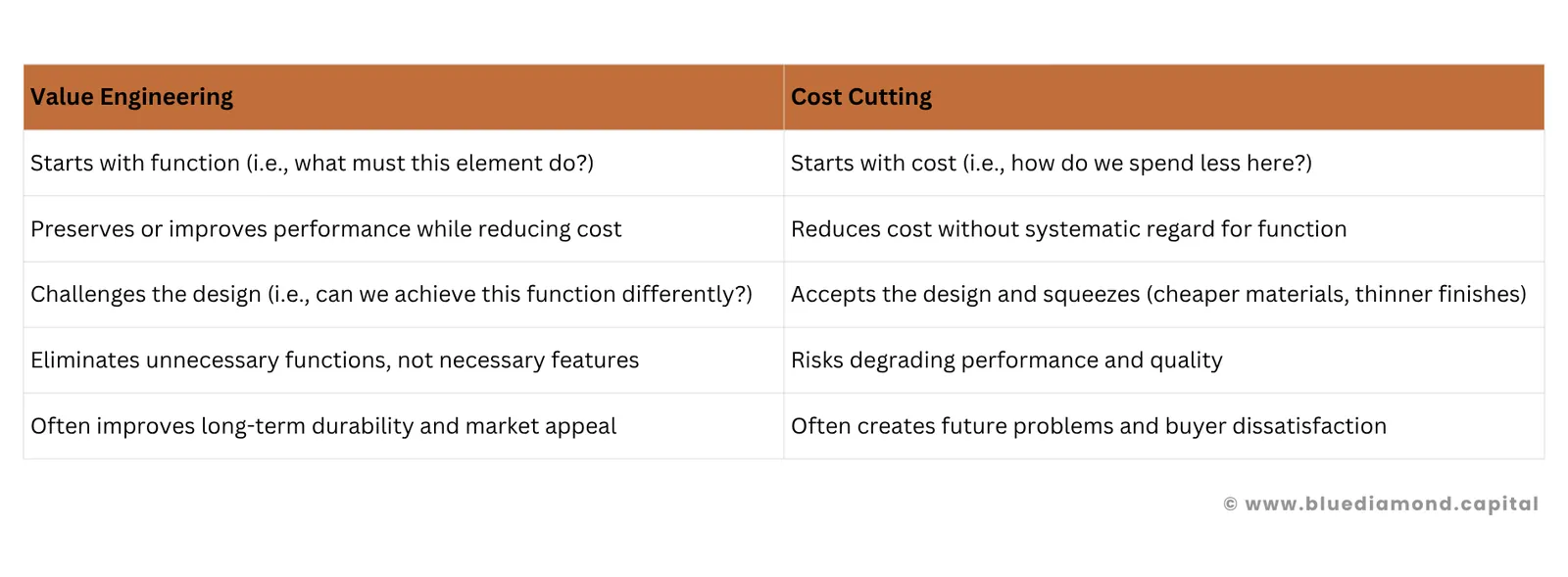
The key question value engineering asks is not "can we find a cheaper option?" but "what function does this element serve, and is there a better way to achieve that function?"
Planning a project in Mauritius?
We act as your client representative from the first drawing to handover, protecting your budget, your timeline and your peace of mind.
This article was first shared on LinkedIn.